
Market Capitalization: The Most Misunderstood Number in Investing
One of the biggest mistakes new investors make is assuming a low-priced stock is “cheap” and a high-priced stock is “expensive.”
That’s almost never true.
The number you should be looking at isn’t the stock price.
It’s the market capitalization, or simply market cap.
What Is Market Capitalization?
Market capitalization is the total value of a company’s outstanding shares.
Think of it as the market’s estimate of what the entire company is worth.
The Formula
Market Cap = Share Price × Shares Outstanding
Simple.
If a company has:
- Share Price: $100
- Shares Outstanding: 1 billion
Then:
Market Cap = $100 × 1 billion = $100 billion
That company is worth $100 billion in the eyes of the market.
Why Stock Price Doesn’t Matter
Let’s compare two companies.
Company A
- Share Price: $20
- Shares Outstanding: 10 billion
- Market Cap: $200 billion
Company B
- Share Price: $500
- Shares Outstanding: 100 million
- Market Cap: $50 billion
Many beginners think Company A is “cheaper” because the stock only costs $20.
In reality, Company A is worth four times more than Company B.
The stock price alone tells you almost nothing.
Why Market Cap Matters
Market cap helps investors answer important questions.
- How big is this company?
- How much room does it have to grow?
- How much risk am I taking?
Generally speaking:
Large Cap
- Over $10 billion
- More established
- Lower risk, slower growth
Mid Cap
- $2–10 billion
- Balance between growth and stability
Small Cap
- Under $2 billion
- Higher risk
- Greater upside potential
The smaller the company, the easier it is for new money to move the stock.
Real-World Example
Imagine Company X is worth $20 billion.
If the company doubles in value, it becomes a $40 billion company.
Now imagine a trillion-dollar company.
For it to double, investors would need to add another trillion dollars in value.
That’s much harder.
This is why smaller companies often produce larger percentage gains.
Market Cap Doesn’t Tell the Whole Story
Market cap is a great starting point, but it isn’t everything.
It doesn’t account for:
- Debt
- Cash on the balance sheet
- Profitability
- Revenue growth
- Valuation
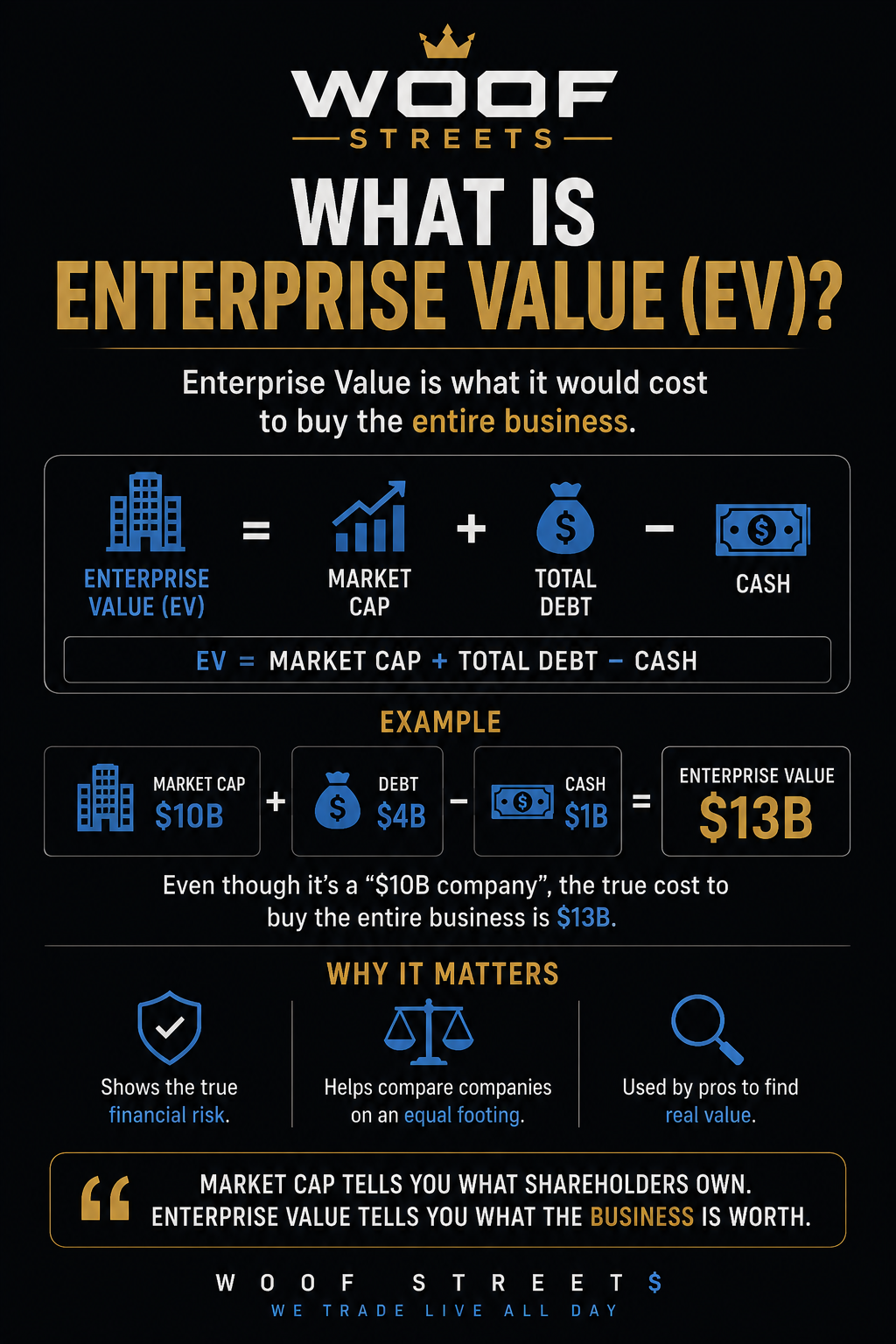
That’s why professional investors also look at Enterprise Value (EV)—which we’ll cover in the next lesson.
Final Thoughts
If you remember one thing, remember this:
A $5 stock isn’t automatically cheap. A $500 stock isn’t automatically expensive.
The only way to understand a company’s size is to look at its market capitalization.
Before you buy any stock, ask yourself one simple question:
“How much is the entire company actually worth?”
That question alone will make you a smarter investor than most beginners.
Whether you’re just getting started or leveling up your game, Woof Streets is where traders learn, grow, and hunt — together.
We’re a Discord trading community built on trust, transparency, and real results.
We’re a fast-growing community of traders, analysts, and market junkies who know that the best setups don’t bark… they growl. Whether you’re here to learn or to ride the waves with a loyal crew, you’ve found your pack.